Through advanced filtration technology and high - quality materials, we ensure that our DPFs meet the most stringent environmental standards helping to improve air quality and protect the environment.
Through advanced filtration technology and high - quality materials, we ensure that our DPFs meet the most stringent environmental standards helping to improve air quality and protect the environment.

Particle trap regeneration refers to the gradual increase of particulate matter in the trap during long-term operation, which can cause an increase in engine back pressure and a decrease in engine performance. It is necessary to regularly clean the deposited particulate matter to restore the filtering performance of the trap.
The regeneration of particle traps can be divided into two methods: active regeneration and passive regeneration
Active regeneration is the use of external energy to increase the temperature inside the trap, causing particles to ignite and burn.
When the temperature in the trap reaches 550 ℃, the deposited particulate matter will oxidize and burn. If it is less than 550 ℃, excessive sediment will clog the trap. At this time, external energy sources (such as electric heaters, burners, or changes in engine operating conditions) need to be used to increase the temperature inside the DPF to oxidize and burn the particulate matter.
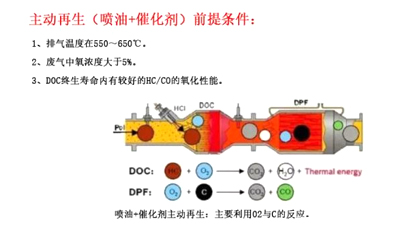
Passive regeneration is the use of fuel additives or catalysts to reduce the ignition temperature of particles, allowing them to ignite and burn at normal diesel engine exhaust temperatures.
Additives (such as cerium, iron, and strontium) need to be added to the fuel in a certain proportion. Excessive additives can affect the lifespan of DOC, while insufficient additives can lead to delayed regeneration or increased regeneration temperature.